
The "Break-Even" Trap: Why Waiting to Recover Your Cost is Costing You Wealth
The "At Least" Mentality
We have all been there. You bought a "hot tip" stock or a sector fund during a bull run at ₹500 per unit. Today, it is languishing at ₹350.
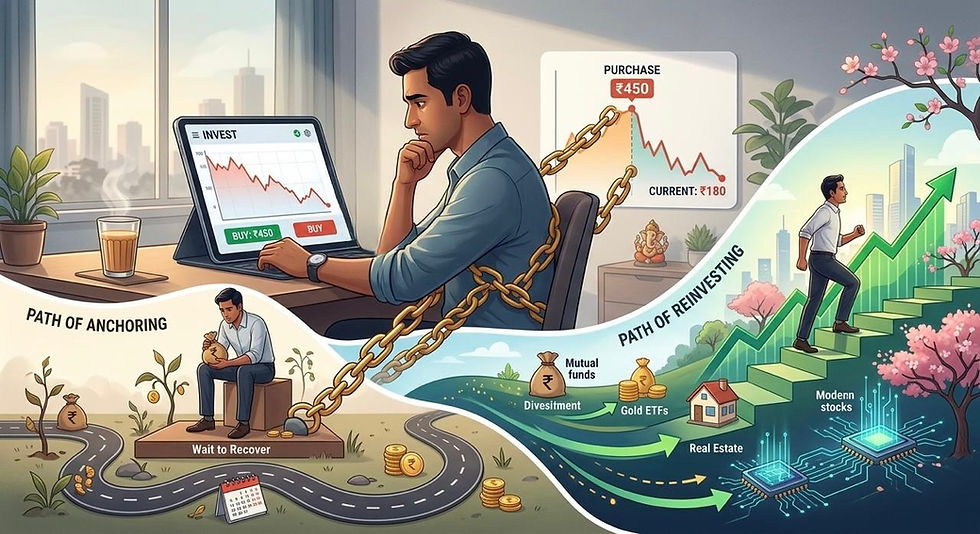
Every time you open your portfolio app, you see that angry red number. But instead of selling and moving on, you tell yourself, "I won't book a loss. I will wait until it reaches ₹500—at least let me get my capital back—and then I will exit."
This sounds logical, right? Wrong. In behavioral science, this is called Anchoring. You are mentally "anchored" to your purchase price. But here is the harsh truth: The market does not care what you paid.
What is the Sunk Cost Fallacy?
Imagine you walk into a cinema hall. You paid ₹800 for a premium ticket and popcorn. Thirty minutes in, you realize the movie is absolutely terrible. It is boring, loud, and nonsensical.
You have two choices:
Leave: You lose ₹800, but you save 2.5 hours of your life to do something fun.
Stay: You lose ₹800 plus you suffer for 2.5 hours.
Most people stay. Why? "Because I paid for it".
This is the Sunk Cost Fallacy. The money is gone. It cannot be recovered. Your decision now should be based on the future, not the past expense.
Investment Context: Your "Purchase Price" is the movie ticket. If the fundamental story of the stock/fund has turned bad (the movie is terrible), staying invested to "recover cost" is punishing your portfolio twice.
Let’s do the math-
Scenario: You have ₹1 Lakh stuck in "Bad Stock A" (Current Value). You bought it for ₹1.5 Lakhs (50% loss).
The Goal: You want your portfolio to reach ₹1.5 Lakhs again.
You have two paths:
Path A (Stubbornness): You wait for "Bad Stock A" to jump 50%. If the company has poor governance or declining sales, this might take 5 years or forever.
Path B (Switching): You sell "Bad Stock A", take the ₹1 Lakh, and invest in "Good Fund B".
If "Good Fund B" grows at 12% annually, you will recover your capital much faster than waiting for a dead stock to perform a miracle.
Key Lesson: It doesn't matter which stock recovers your money, as long as your portfolio recovers the value.
The Dangerous Habit: "Averaging Down"
When a stock falls, many investors think, "Great! It’s cheap. Let me buy more to lower my average cost."
Good Averaging: Buying more of HDFC Bank or Nifty 50 when the market corrects. (The fundamentals are strong).
Bad Averaging: Buying more of a company that has fraud allegations or massive debt just to feel better about your loss.
In the industry, it is called "Catching a Falling Knife". You aren't investing; you are throwing good money after bad to protect your ego.
The "Overnight Test"
Here is a mental trick to break the Anchoring effect.
Ask yourself: "If I didn't own this investment, and I had the cash equivalent in my hand right now, would I buy this investment today?"
If the answer is YES: Great, hold it. The drop is just market volatility.
If the answer is NO: Then why are you holding it? Sell it immediately.
Frequently Asked Questions
Q: But if I sell at a loss, isn't that real money lost?
A: The money was lost the day the price dropped. Your portfolio value shows the current reality. Selling just makes it official for tax purposes (which can actually help you save tax via Loss Harvesting!).
Q: How do I distinguish between "Patience" and "Anchoring"?
A: Patience is holding a good company through bad market moods. Anchoring is holding a bad company, hoping for good luck. Check the fundamentals of the company/fund, not just the price.
Conclusion
Your portfolio is like a garden. If a plant is diseased, you don't water it more; you remove it to protect the soil for new seeds. Don't let your past purchase price dictate your future wealth.
Happy Investing!



Comments