
Family Floater vs Individual Health Cover: Large Biryani Pot or Individual Thalis?
In India, we love sharing. We share our food, our festivals, and often, our homes. But when it comes to financial planning - specifically Health Insurance, sharing isn't always the safest option.
With medical inflation in India hovering around 12-14% (way more than the general inflation rate), a single hospitalization can wipe out years of savings. The most common question we get from clients is "Should I buy a single policy for my whole family, or separate ones for each member?"
To make this simple, let’s look at it through a lens every Indian understands: Dinner.
The "Biryani Pot" (Family Floater Plans)
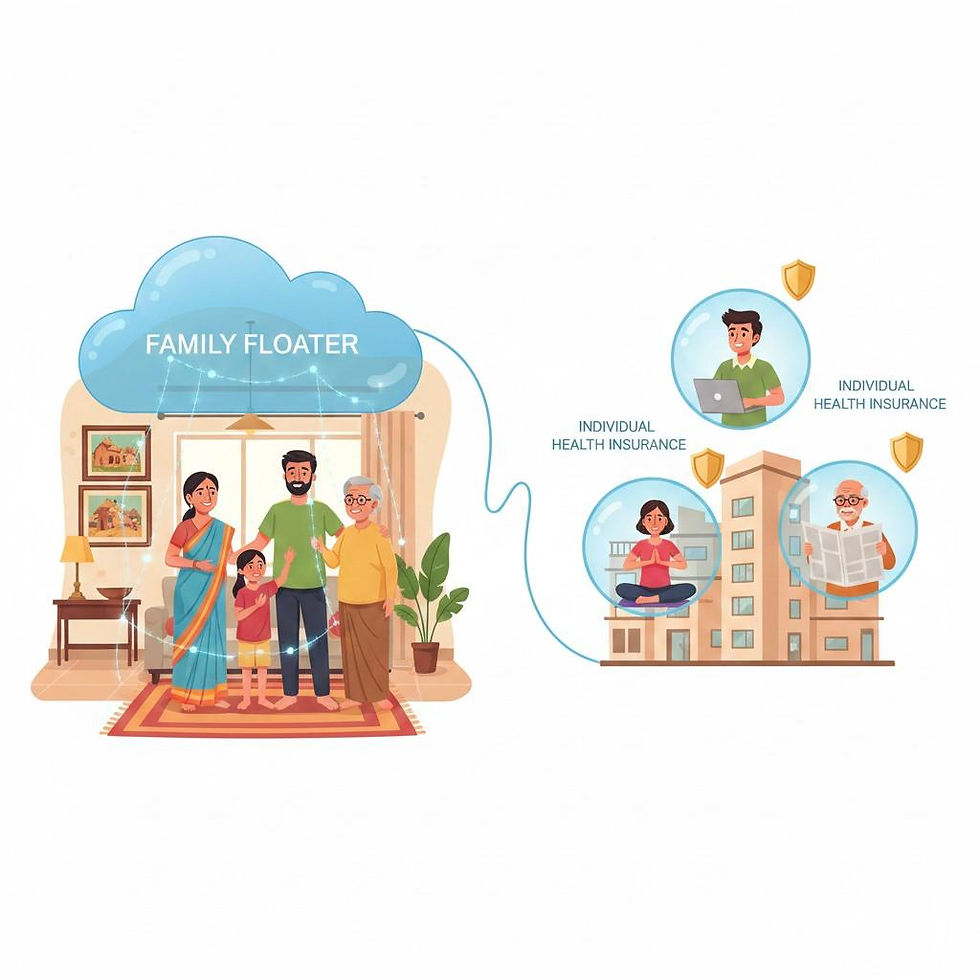
Imagine ordering a Family Floater Plan. This is like ordering one large Handi of Biryani for the table.
How it works: You buy a ₹10 Lakh cover. You, your spouse, and your kids share this ₹10 Lakh. One policy, One total Sum Insured, Coverage shared by all included members
The Benefit: It is cheaper. Just as one large pot is cheaper than four separate meals, the premium cost for a Floater plan is generally lower than the sum of individual policies. It is also easier to manage - one renewal date, one document.
Risk: What happens if one person has a massive appetite? If your father falls ill and utilizes ₹8 Lakhs of the cover (eats 80% of the Biryani), the rest of the family is left with only ₹2 Lakhs for the remaining year. If a second emergency strikes, the pot is empty. Enough biryani (sum insured) is very much necessary here.
Family Floaters are excellent for young nuclear families (husband, wife, kids) where the probability of multiple members falling sick in the same year is low. Large cover is recommended here.
The "Individual Thali" (Individual Health Plans)
Now, imagine Individual Plans. This is like ordering a separate Thali for everyone.
How it works: You buy a ₹10 Lakh cover for each person.
The Benefit: Security. If your father uses his full ₹10 Lakhs, your mother’s ₹10 Lakhs remains untouched. Everyone has their own quota.
The Bonus Advantage: In a Floater plan, if one person claims, the "No Claim Bonus" (NCB) for the whole family drops to zero. In Individual plans, only the sick person loses the NCB; others continue to get their bonus increase. However, NCB as a feature is losing its shine and better product features are available to avoid this issue.
The "Senior Citizen" Trap: A Common Mistake
This is where you may make a blunder. Adding your 60+ year-old parents to the same Floater plan as your 5-year-old daughter.
Premium Spike: The premium of a Floater plan is determined by the age of the oldest member. Your senior parent's age will make the premium expensive for everyone.
High Consumption: Seniors are more likely to claim. They might exhaust the cover, leaving the young children vulnerable.
The Golden Rule: Treat your parents to their own Thali. Keep them on a separate Senior Citizen or Individual policy. Keep the Floater for the husband, wife, and kids.
The "Super Top-Up" Strategy
If you feel the "Biryani Pot" (Floater) is risky because the quantity might be too less, you don't necessarily need to switch to expensive Thalis. You can simply order extra rice on the side.
This is called a Super Top-Up Plan. You buy a base Floater of ₹10 Lakhs (cheaper) and a Super Top-Up of ₹20 Lakhs (cheaper too). If your hospital bill crosses ₹10 Lakhs, the Top-Up kicks in. This gives you massive coverage at a fraction of the cost.
Summary
Feature | Family Floater (Large Biryani) | Individual Cover (Individual Thali) |
Who is covered? | Multiple members under one policy | Each member has own policy |
Sum insured sharing | Shared pool | Separate for each person |
Premium cost | Usually lower for young, healthy families | Higher overall, but more robust |
Ideal for | Young couples, small kids | Senior citizens, people with illnesses |
Impact of one big claim | Reduces cover for everyone | Affects only that person’s cover |
Ease of management | One renewal, one policy | Multiple renewals, more tracking |
Adding parents | Usually not recommended | Better to keep them separate |
FAQs:
1. Can I claim tax benefits for both plans?
Yes! Under Section 80D, you can claim up to ₹25,000 for yourself/family and an additional ₹25,000 (or ₹50,000 if they are seniors) for premiums paid for your parents.
2. What if I have a company corporate cover?
Corporate cover is like the free snacks at a wedding - good to have, but don't rely on it for dinner. If you lose your job, you lose the cover. Always have a private personal policy.
3. Can I convert or split a Family Floater policy to an Individual Cover if needed?
Many insurers allow you to:
Increase cover
Shift members out and give them individual covers
But premiums and medical conditions at that time will matter. It’s better to plan structure correctly at the start with guidance.
Conclusion
Family floater vs individual cover is not just a premium comparison. It is a risk management decision for your entire family’s health and wealth.
If you’re a young, healthy nuclear family → Floater is usually a good, economical choice.
If you have older parents or high health risks → Use individual covers or separate senior floater.
In many cases, a Hybrid mix + Super Top-up gives the best balance.
Before you decide, list your family members, ages, health conditions, city, and budget. Then discuss once with a qualified advisor who understands both insurance products and your life goals.
Happy Investing!



Comments